Tuesday, August 25, 2009

reading form

voordouw_2

image

Photos courtesy of horhizon.com & suckerpunch

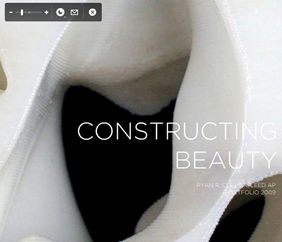
As a continuation from the previous post (and found through my love of suckerPUNCH) this recent project printed aedicules by Johan Voordouw explorers the “conventional modes of architectural expression, text, drawings and models, into a singular spatial formation,” essentially marrying the figural page shape with literal “sls” or plastic 3d print modeling and graphics. The project discusses work surrounding the Villa d’Este in Tivoli – a subject which I’m sure influenced the figuration of the form/shape/graphic/text/whatever.

Now, imagine a portfolio with 3d models, great text, video, graphics, and what not all in one binding. Not that were graphic designers, but the ability to negate abstraction of form (ie, the line/ the 2d condition), in favor of pure form, is so incredibly seductive.

by Voordouw (via suckerpunch):

The project describes an annexed library for the museum of manuscripts at Villa d’Este in Tivoli, Italy. Rather than exploring the configuration of conventional spaces the project sought to explore the library through a series of books, the book becoming an expression of physical and imagined spaces. Using a combination of text, illustrations and SLS models the project formed architectural space on and through the page, an oscillating interplay between two-dimensional and three-dimensional space and experience, one that can only be fully appreciated when flipping cover to cover.

The spaces within the book are hand-carved to blur the boundary between model and paper. The book, first digitally modeled was then physically crafted, the voids forming the context for the content; the models, images and text continually reveal additional information about the intensions of the library creating a link between reading the book and reading the building. This re-forms Victor Hugo’s assertion of architecture as didactic space, a place with continual exploration and discovery.

image

voordouw_2

Wednesday, August 19, 2009

Portfolio_VIP

video in print – the inclusion of very thin, very small videos within the printed medium

And why not? (well, other than expense, technical difficulty, proprietary technology, whatever…)

I don’t believe this is at all gimmickish - if done right. Animation could really explain certain works (as perhaps best shown by Joshua Prince-Ramus about his work on Ted Talks, see the last 3 minutes or so…), and would provide a completeness to the project that would be unobtainable any other way. This would, in a way, spoil much of the modeling technique spawned today throughout the profession – that is, only model what will render – and produce a stock of work that further investigates affect – another argument for the study of the workings of cinema in terms of architectural expression.

If nothing else it might better portfolios in some way – imagine using both print and video in the same printed portfolio…

Monday, August 10, 2009

parametric study – solar articulation/surface aggregation

 Solar PassThrough July 15 v5

For this study, I was asked to design a skyscraper who accommodates a system of panelization in which each panel is to be normal to the sun. One could think of these as either solar shades or PV panels. This condition allows for a level of sustainability about tall, topological projects, while still allowing the architect to control form while keeping the surfaces developable.

A number of steps went into solving the problem:

  1. Planar surfaces where created from the NURBS surface using LIFT Architects Grasshopper Primer.
  2. I then divided each panel into a 2x2 grid using U & V values, which yielded 9 points. I then extracted the corner points (1, 3, 7, and 9) and the middle points (5) into two distinct lists, or arrays.  Logic Diagram Scan
  3. To create surfaces normal to the sun, I used trigonometry based on the vectors between the sun and the center/corner points of the original diagrid pieces. Because the magnitude (length) of the pre-existing vectors are known (both to the corners and to the center) as well as the angle between those vectors, a cosine function can be used to determine planar points along the corner vectors. Basically, as long as all end points of all lines draw a perpendicular vector to the existing central point vector, the surface, by definition, will be planar (see diagram). 

    GIVEN
    Logic Diagram Scan

    SOLUTIONLogic Diagram Scan

  4. Once I had the four new corner points, I used a ‘surface from four points’ component and baked the geometry into Rhino.

Because of the parametrics of grasshopper, one can view all possibilities of each panel, the number of panels, change the solar path relative to the building, etc.

To find the solar data I used an excellent excel spreadsheet put out by Greg Pelletier through the Washington State Department of Ecology (titled solrad.xls v1.2). It can be found on the web here.

image Additional geometries can be explored (such as VT’s solar decathlon house wall pattern) which would do the same technique, in aggregation, which would perhaps give more variation to the work.


Images

(panels fixed in July position except in the video)

Interior Perspectives (January vs. July)

Solar PassThrough January 15 Solar PassThrough July 15

Solar Pass OverallSolar PassThrough July 15 v3

Solar PassThrough July 15 v2 

image

If the panels were to move in relation to the sun, it would look something like this (July solar data, of course):  

Sunday, August 2, 2009

FlightPath

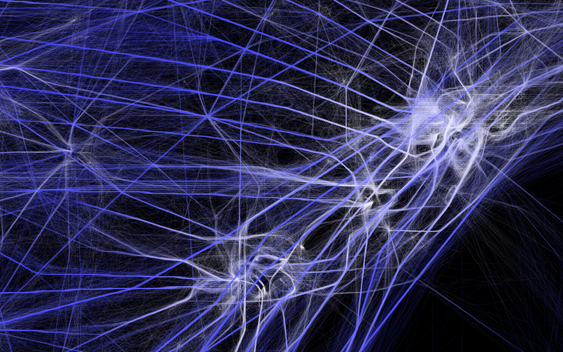
Aaron Koblin – Sand Box – Flight Paths

The paths correlate with various data tracking various flight paths about the US. I find the output (I hazard to say work…) to be quite beautiful in a way; the geometries are figural and, though complex, they seem to resemble some sort of logic, both in direction as well as in time (see the pulsing in the video).

The project also resembles the work done on processing (link to flickr stream | example 1 | example 2), the script used by Michael Hansmeyer in his Platonic Solid project, although the two do look entirely different…

Ultimately, in all of these, its not the script or the data that really matters: it is only (and will only ever be) the geometry, the articulation, and the beauty that captivates.

Images from the site:

northeastfloridaatlanta

Tuesday, July 21, 2009

a SWELL project

IMG_2665 edit

Professor Gabriel Esquivel

Ryan R. Collier – Project Manager

Nick Cignac | Matt Richardson | Todd Christensen | Mitch Scott Rocheleau | Chris Gassaway

“life is nothing but instability and disequilibrium... a swelling tumult continuously on the verge of explosion.” ~ Georges Bataille

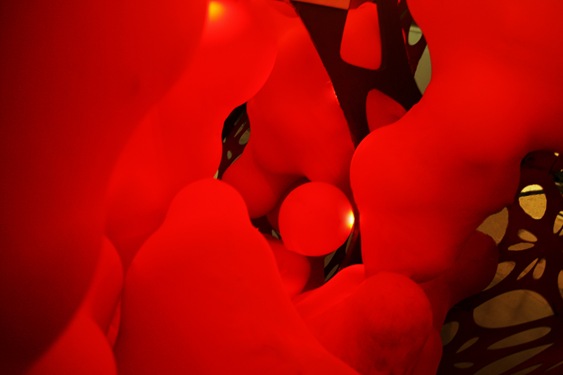
“Swell” emerged from the posture of presenting an argument emerging from architecture itself. Is it possible to talk about architecture from its own discourse? This project fits within the continuum of architecture through references from works of the classicists to early modernists. A significant part of the research revolved around the discussion of classical ornamentation: a layer of architecturalization that was perhaps best articulated by the early modernist Louis Sullivan as seen in his intricate, highly articulated Guaranty Bank(i) corner to cornice detailing.

clip_image001Not unlike the Baroque, there is a sense of levitation and anticipation – a feeling that the swell condition will either a) cause the entire beam to ultimately invade the floor and spread as a viscous fluid, or b) explode under the pressure of the aforementioned systems. Ironically, although the swell condition creates the illusion of weight, the project is - because of geometry, castellation, and material studies - quite the opposite. Furthermore, the form can be understood as an exaggerated moment diagram, as if the weight of the interior is causing deformation about the middle of beam.

This project addresses a classic architectural problem of the column/beam or more literally the corner/beam condition, a swelling condition in this case. The space includes a logic of ornamentation through aggregation of apertures and voids about the surface. To the benefit of the whole, two subservient (submissive) systems work concurrently, interdependently to erect an affect of Swell. Arguably, the one system without the other would be beautiful, but without any sense of abjection. Abject then is the state in which the object begins merging with the subject, literally dissolving the boundary between the two; the abject replaces the object. As the two systems invade the other and create such interaction, the composite condition begins to swell under pressures, literally ripping the surface: apertures graze the surface where there were none. The micro condition of the porous appears taut via stretching of certain geometries, ultimately achieving a high porosity the swelling turning into poché. This poché is the condition of the surface against the softbodies, a system beginning to distend: an infinite cleavage, a condition of invaded interstitial spaces.

The interstitial space, implied or contained is interpreted as a suppression of the paradox of physics and metaphysics of space that aims for an argument of desire, or that of the seductive void.

The void then can assume various shapes/relations. The question is whether or not the void is understood as a condition of interiority or exteriority. Our subjective affiliation to the project could be explained as the classic repression exercised by the superego, exposing another way to look at it in terms of the “other," in which otherness is present within the subject: a condition of abjection. “The interiority of exteriority is not understood until the internalization of absolute alterity disrupts the self conscious subject by revealing the presence/absence of an unconsciousness that can never fully enter consciousness”.(ii) Since the outside is always inside, the self is, in some sense, forever outside itself. The seductive “within” is not merely a need that can be filled by the possession of an object: the discourse of the other signifies an insatiable desire.

“Swelling” is presented as a disruptive condition that argues emotional possibilities, from its sensual and ominous ornamentation to questions whether it is psycho sexual, an explosion, or simply a disruption of the condition of the surface?


(i) Image provided by: http://www.wrightnowinbuffalo.com/whattodo/images/Guaranty4.jpg

(ii) Jacques Lacan, Ecrits. A. Sheridan. New York; Norton 19

*Construction documents available upon request.


IMG_2648 edit IMG_2697mdf   

IMG_2675 edit (2)

IMG_2579 edit IMG_2392

IMG_2661 edit IMG_2666 edit IMG_2656 edit

IMG_2380 IMG_2360

IMG_2344 edit IMG_2381 IMG_2157 edit

IMG_2273 edit

Monday, June 1, 2009

Education and Sensation: Renderings

I put this off till I had a bit more time. Here are the renderings (along with some images from before) that I’m submitting to a competition later on this month.

street facade

perspective_02

exterior perspective

Picture1

exterior perspective

Picture5

interior perspective – typical affect condition

Picture2

interior perspective – typical toddler area

Picture3